
The First Thing a Conqueror Does Is Find Out What Everyone Owns. The Second Thing Is Tax It. England Has Been Running That System Ever Since.
Your taxes and property valuations still run on a system built in 1086. No other medieval document has a more direct line to your annual financial obligations today.
THE HUMAN MOMENT
Somewhere in England right now, a letter is arriving. It might be a council tax bill, recalculated because the Valuation Office has reassessed your property band. It might be a letter from HMRC advising that your deceased parent’s estate has been reviewed and inheritance tax is owed. It might be a Land Registry notification confirming that your new home has been formally recorded as yours, with its exact value logged in a government database. Whatever form it takes, the underlying logic is identical: the state knows what your property is worth, has written it down, and intends to collect from it.
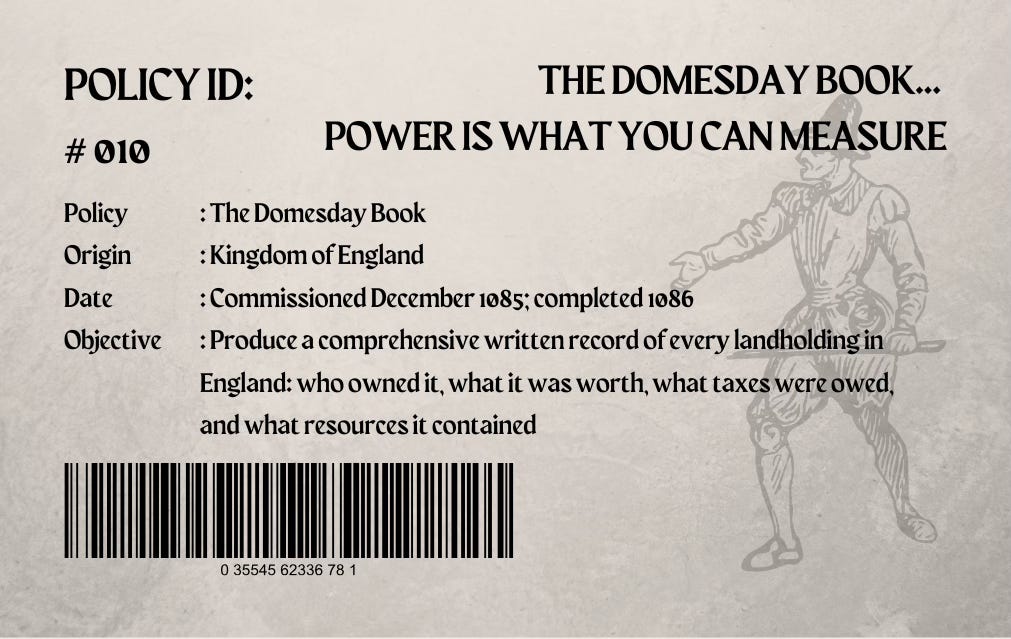
That logic did not begin with the modern tax code. It did not begin with the welfare state, or with Victorian fiscal reform, or even with the land tax acts of the 17th century. It began in the winter of 1085, when William the Conqueror sat at Gloucester and ordered his officials to survey every hide of land in England. The document they produced, completed in a single extraordinary year and deposited in the royal treasury at Winchester, recorded the name of every landholder, the value of every estate, the number of ploughs, villagers, and slaves on every manor, and the taxes owed to the Crown from each one. It covered 13,418 settlements across almost the whole of England. The Anglo-Saxon Chronicle, whose authors were not given to hyperbole, recorded with visible unease that not one yard of land, not one ox, not one pig, was left out of his record.
The people of England called it the Domesday Book, meaning the book of final judgement, because its rulings on ownership and value admitted no appeal. Whatever it said, that was the law. Nine hundred and forty years later, the state is still doing exactly what William’s commissioners did in 1086. The method is digital rather than parchment, the officials are HMRC rather than Norman bishops, and the penalties for under-declaration are fines rather than forfeiture. But the structure is the same: the government has a record of your property, and you are taxed according to it.
THE POLICY BACKSTORY
William I had conquered England in 1066 and spent the following two decades attempting to consolidate an occupation that was deeply resented and periodically violent. By late 1085, he faced a specific and urgent crisis. King Canute IV of Denmark was assembling a fleet for an invasion that never came but which looked imminent at the time. William needed to know exactly what military and financial resources he could draw on, and he needed to resolve the chaos of conflicting land claims that had accumulated since the Conquest: Norman barons had been rewarded with Anglo-Saxon lands, those lands had changed hands through death and forfeiture, and the resulting disputes were consuming enormous amounts of court time and creating dangerous instability among his own followers.
The survey he commissioned was unprecedented in its ambition and remarkable in its execution. The kingdom was divided into seven circuits, and panels of royal commissioners, mostly senior bishops and barons trusted by the king, were dispatched to each. Crucially, the commissioners were assigned to circuits where they held no land themselves, to limit the opportunity for self-interested manipulation. In each county they convened the local courts, summoned representatives of every manor, and asked the same questions under oath: what was the place called, who held it at the time of King Edward the Confessor in 1066, who held it now, how much was it worth then, how much was it worth now, how many villagers, smallholders, slaves, and ploughmen worked it, and how much tax was owed. Each estate was assessed not once but three times, at its pre-Conquest value, its current value, and its value when the Norman lord first took possession.
Oxford historian Professor Stephen Baxter’s research, published in the English Historical Review in 2020, established that the first draft of the survey covering the south-west of England was completed within 100 days. The entire survey of England south of the rivers Ribble and Tees, covering thousands of manors across dozens of counties, was compiled, checked, reorganised, and delivered to Winchester within approximately seven months. The finished record covered 268,984 named heads of household and estimated a total population of between 1.2 and 1.6 million people. It was, as Baxter put it, one of the most remarkable feats of government in the recorded history of Britain.
THE SCORECARD
W.01: The Domesday Book created the first systematic state record linking identity, property, and tax liability, which is the foundational architecture of every modern fiscal system
[Pillar: Financial | Political & Civil Liberties]
Before the Domesday Book, English taxation operated on the basis of an ancient and increasingly obsolete assessment system called the geld, levied on units of land called hides, whose values had not been updated since before the Conquest and bore only a loose relationship to actual economic output. What William’s commissioners produced was something qualitatively different: a live snapshot of actual property values, actual ownership, and actual taxable capacity, verified under oath, covering almost the entire kingdom simultaneously.
This was the first time any Western government had systematically linked the question of who owns what to the question of how much they owe in tax, in a single written national record. The three-point assessment of each estate, recording its value before the Conquest in 1066, at the time of acquisition by its Norman lord, and at the time of the survey in 1086, created a comparative baseline that allowed officials to identify underperforming estates, fraudulent undervaluation, and disputes over rightful ownership. It was not just a tax record. It was an audit tool.
The direct institutional lineage runs from the Domesday Book through England’s Land Tax of 1692, the Valuation Office established in 1910 to assess properties for Lloyd George’s land value tax, the post-war rates system, and the current council tax bands, which in England are still based on property valuations last updated in 1991. Every time a government official assigns a taxable value to a piece of land and sends the bill to its owner, they are performing a task whose basic logic, structure, and justification was established in a Winchester scriptorium in 1086.
Score: +1
W.02: The Domesday Book established the principle that the state has the right to compel its subjects to disclose their wealth, under oath, for the purposes of taxation, and that this disclosure creates a legally binding record
[Pillar: Political & Civil Liberties | Financial]
One of the most consequential but least discussed aspects of the Domesday survey is the method by which its information was collected and verified. Landholders and their tenants were summoned to appear before royal commissioners and required to give sworn testimony about their property. Witnesses were called to corroborate or challenge claims. The commissioners were required to be strangers to the area they were assessing, specifically to prevent local interests from corrupting the evidence. If a discrepancy was found between what a landholder declared and what the juries of local representatives reported, the landholder could face forfeiture.
This procedure established something that every modern tax authority still depends on: the legal obligation of citizens to self-disclose their taxable assets to the state, truthfully and under penalty of law. HMRC’s self-assessment system, the IRS’s annual filing requirement, and every equivalent institution in every Western democracy all rest on the same foundational principle that William’s commissioners operationalised in 1086. The state cannot individually verify every asset held by every citizen. What it can do is compel disclosure, cross-reference it against other available information, and impose penalties for false declaration. The Domesday Book was the first time this model was applied at national scale in Western history.
The encyclopedia.com summary of Domesday’s procedural significance notes that this may be the earliest use of the inquest procedure in England, and that it established the right of the king to require citizens to give information, a foundation that contributed to the later development of jury procedure in English common law. The administrative innovation and the legal innovation were, in this case, the same event.
Score: +1
L.01: The Domesday Book was simultaneously a tax instrument and a tool of political domination: it recorded and legitimised the most comprehensive expropriation of land in English history
[Pillar: Financial | Social & Cultural | Political & Civil Liberties]
The Domesday Book is impossible to evaluate honestly without confronting what it documented. By 1086, twenty years after the Battle of Hastings, the Norman Conquest had effected the most complete transfer of private wealth in English history. Research using the Domesday data, published by the LSE Economic History department in 2022, found that the lands of over 4,000 Anglo-Saxon lords had passed to fewer than 200 Norman barons. The Norman Conquest Wikipedia article, drawing on the same Domesday evidence, states that by 1086 only about five percent of land in England south of the Tees remained in English hands.
The Domesday Book did not cause this dispossession. It recorded and institutionalised it. By creating an official written record of who owned what in 1086, the survey gave Norman ownership of expropriated Anglo-Saxon land the force of documentary law. The three-point chronology of ownership that the commissioners recorded, comparing the situation before the Conquest with the situation after it, made the scale of the transfer visible. It also made the transfers harder to reverse, because a documented Norman title was now the legal baseline against which any future Anglo-Saxon claim would have to be measured.
This function of the written record, as a tool that legitimises the existing distribution of property by giving it official legal recognition, is not unique to 1086. It is the argument that critics of cadastral surveys and land registries have made in many different contexts since: that the act of formally recording ownership tends to favour whoever holds title at the moment of recording, and to entrench existing inequalities in the structure of the law itself. The Domesday Book is the founding example of this dynamic in Western legal history.
Score: -1
W.03: The Domesday Book created the first Western land registry: a permanent state record of property title that resolved disputes, reduced violence, and provided a legal foundation for property rights that endures today
[Pillar: Financial | Political & Civil Liberties]
Beyond its function as a tax document, the Domesday Book served as an authoritative register of land title. One of William’s explicit purposes in commissioning the survey was to settle the disputes over land ownership that had multiplied since the Conquest and were generating dangerous conflict among his own barons. The book’s popular name, meaning the day of judgement, reflected this function: its rulings were final. There was no appeal from what it said. If Domesday recorded that a manor belonged to a particular lord, that was the legal reality, whatever the competing claims.
This function as a definitive reference point for property title had immediate practical value and long institutional reach. Throughout the medieval period, the Domesday Book was regularly cited in English courts as evidence of land ownership and legal rights. The Wikipedia article on the Domesday Book records that it was cited in a legal case as recently as 2019, to prove the existence of a market. The principle that the state maintains an authoritative written record of land ownership, which can be consulted to resolve disputes and establish legal title, is now so embedded in property law that it is difficult to imagine the alternative. The Land Registry of England and Wales, which holds title records for approximately 26 million properties and processes around six million transactions annually, is the direct institutional descendant of the precedent the Domesday Book established.
There is also a structural point worth making: the existence of a reliable state record of property title makes property itself more economically valuable. Economists Hernando de Soto and others have argued extensively that secure, documented property rights are a prerequisite for economic development, because they allow property to function as collateral, be transferred efficiently, and attract investment. The Domesday Book was the first instrument in Western history to create this infrastructure for an entire kingdom simultaneously.
Score: +1
L.02: The Domesday Book established a template for state surveillance of private wealth that governments have been refining, and expanding, ever since, with consequences that are not always benign
[Pillar: Financial | Political & Civil Liberties]
The Domesday Book demonstrated that it was technically and administratively possible for a government to compile a comprehensive national record of private wealth. Every government that has subsequently attempted to do so has been drawing on the logic William’s commissioners proved workable in 1086. This is not, in itself, a bad thing: the ability to tax wealth fairly depends on knowing what wealth exists. But the history of how this template has been used is not a straightforwardly positive one.
The 1910 Inland Revenue valuation of all land in England and Wales, explicitly nicknamed the 1910 Domesday Books by the government that commissioned it, was designed to levy a land value tax on unimproved land values. The survey was comprehensive, covering every property in England, and was explicitly modelled on its 1086 predecessor. In 2025 and 2026, the debate about comprehensive wealth taxation has returned to the same vocabulary: Tax Justice UK’s recent policy paper arguing for a new wealth tax explicitly called for building a new Domesday Book fit for the modern age, combining HMRC data, Land Registry records, Companies House data, and Valuation Office assessments into a single comprehensive state database of private wealth.
The question this raises is not whether the state should know about taxable wealth, but who controls that information, how it is used, and what safeguards exist against its misuse. The Domesday Book was compiled by a king who had personally decided the distribution of the wealth it recorded. The commissioners were trustworthy men dispatched to areas where they held no land, which was an honest attempt at structural integrity. But the document ultimately served the interests of the conqueror who commissioned it. Every subsequent iteration of comprehensive state wealth surveillance has faced the same question: is this a tool for fair taxation, or a tool for the exercise of power over the taxed?
Score: -1
THE TALLY & THE TENSION
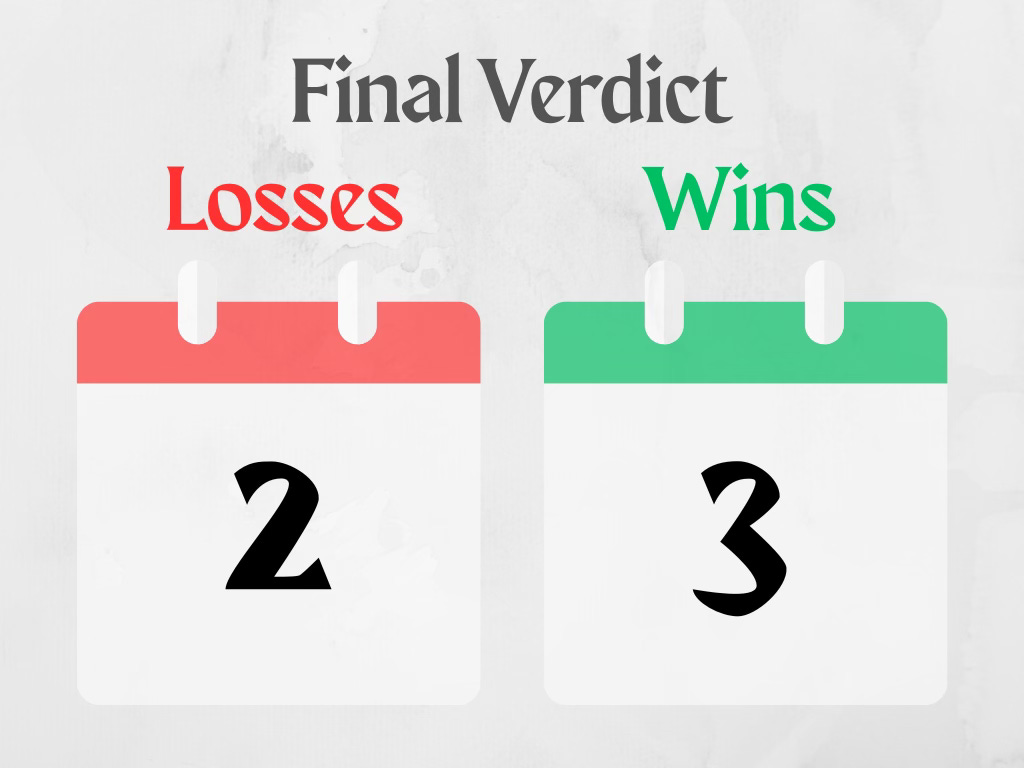
WnL AUDIT SCORE: +1
3 Ws vs 2 Ls
A net score of +1 for the Domesday Book reflects something genuinely remarkable: a document whose core institutional architecture, linking identity to property to tax obligation in a single state-held record, has proven so effective that it has never been replaced, only refined. The three Ws are durable in a way that few medieval policy innovations are. The principle of a national land registry, the legal framework of sworn disclosure to the state, and the system of documented property title collectively underpin the entire property law and taxation infrastructure of the modern world. That is not a small inheritance. But the two Ls sit inside the same structure. The Domesday Book is proof that the same tool can simultaneously protect rights and suppress them, depending entirely on who holds the record and whose interests it serves. In 1086 it was a conqueror’s instrument. In 2026 it is the architecture of the tax system. The difference is less absolute than it might appear: both versions of the system were built by people with power, for the primary purpose of extracting value from people without it.
THE LIVE WIRE
In March 2026, the UK’s Spring Statement triggered a renewed debate about property taxation, with economists from the Resolution Foundation and the Institute for Fiscal Studies both arguing that England’s council tax system, based on property valuations frozen at 1991 levels, had produced a tax on property wealth that is systematically regressive, taxing modest homes in the north of England at proportionally higher rates than high-value properties in London and the south-east. The solution proposed by both institutions was a revaluation: a new comprehensive government assessment of every residential property in England. In other words, a new Domesday survey.
At the same time, the debate about wealth taxes in the UK, US, and across Europe has repeatedly returned to the same administrative obstacle that has always confronted governments trying to tax wealth comprehensively: the state does not have a sufficiently complete or accurate record of who owns what. Offshore holdings, complex trust structures, and assets held in jurisdictions with limited disclosure requirements mean that the comprehensive wealth database that would be needed to tax wealth effectively does not yet exist. Tax Justice UK’s 2026 policy paper called explicitly for building that database, describing it as a new Domesday Book fit for the modern age.
The political argument about whether such a database should exist, and what it should be used for, is precisely the argument the Domesday Book started in 1086. William’s subjects called his survey the book of final judgement because they understood that a government record of your wealth is a government record of what you can be made to pay. Nine centuries later, the argument about how comprehensive that record should be, who should have access to it, and whose interests it should ultimately serve is as unresolved as it was when Norman commissioners rode into the first English villages with their lists of questions and their powers of forfeiture. The method has changed. The structural tension has not.
Wowwww... very interesting! Curious what the other Ws and Ls were 😊
Great knowledge keep going here to connect